Jesus Takes Away the Sin of the World / John 1:29–42 / Pr. Ted A. Giese / Sunday January 18th 2026/ Season of Epiphany / Mount Olive Lutheran Church
Mount Olive Lutheran Church / Pr. Ted A. Giese / Sunday January 18th 2026: Season of Epiphany / John 1:29–42 “Jesus Takes Away the Sin of the World!”
The next day [John the Baptizer] saw Jesus coming toward him, and said, “Behold, the Lamb of God, who takes away the sin of the world! This is He of whom I said, ‘After me comes a man who ranks before me, because He was before me.’ I myself did not know Him, but for this purpose I came baptizing with water, that He might be revealed to Israel.” And John bore witness: “I saw the Spirit descend from heaven like a dove, and it remained on Him. I myself did not know Him, but He who sent me to baptize with water said to me, ‘He on whom you see the Spirit descend and remain, this is He who baptizes with the Holy Spirit.’ And I have seen and have borne witness that this is the Son of God.”
The next day again John was standing with two of his disciples, and he looked at Jesus as He walked by and said, “Behold, the Lamb of God!” The two disciples heard him say this, and they followed Jesus. Jesus turned and saw them following and said to them, “What are you seeking?” And they said to him, “Rabbi” (which means Teacher), “where are you staying?” He said to them, “Come and you will see.” So they came and saw where He was staying, and they stayed with Him that day, for it was about the tenth hour. One of the two who heard John speak and followed Jesus was Andrew, Simon Peter’s brother. He first found his own brother Simon and said to him, “We have found the Messiah” (which means Christ). He brought him to Jesus.”
Let us pray: May the words of my mouth and the meditations of all our hearts be acceptable in Your sight O Lord. Amen.
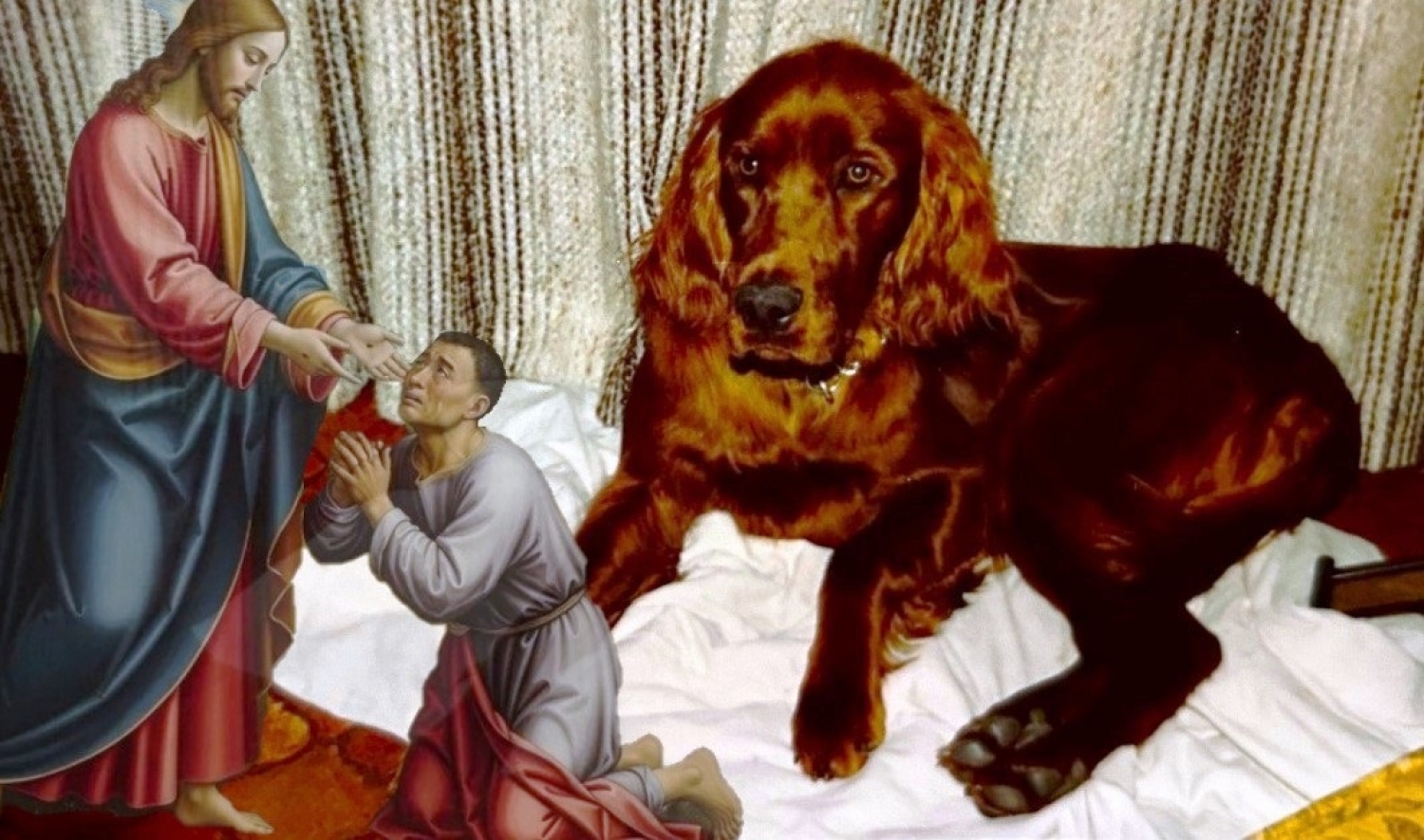
Grace peace and mercy to you from God our Father and from our Lord and Saviour Jesus Christ. Good Christian Friends, as a rule I don’t talk about myself very much in sermons, today however let me tell you about two dogs from our family Rover and Rusty:
Rover was my grandfather’s dog; he was a Black Labrador Retriever, an award winning hunting dog. Raised right Rover was a farm dog trained to stay by the back door leading into the kitchen and didn’t come really into the rest of the house. When it was bitterly cold outside he’d ring the back door bell with his paw and once inside he’d contently sit on a warm back door mat. Out hunting ducks or geese or pheasants if my grandfather missed his shot, Rover would look back at him with surprise wondering what went wrong. Rover was a good dog and when he was about twelve or so years old and arthritis had settled into his hips he was taken away and put down and it was very sad for everyone that knew him. Rover was my grandfather’s last hunting dog; Rover died before I was born.
 Rusty was our dog; he was a Irish Setter, never won an award that I’m aware of, we got him from the city and brought him to our acreage in the country. Rusty howled at the moon and barked at every sparrow that caught his eye. He had to be kept on good long chain or he’d run away for days at a time through the slough and make mischief with the neighbours and their dogs. My folks had to go to court because the pound was always after him. Rusty wouldn’t always sit nicely by the back door when he came into the house and I remember finding him one day standing in my bedroom and peeing on the carpet. Rusty was a bad dog. After a couple years my folks gave him away. We loaded Rusty and the doghouse and the dog dish and the dog food and the dog toys into the back of their pickup truck and when they took Rusty away my mother said, “Even the children didn’t cry.” No one was sad to see Rusty go. He was our last dog.
In our Gospel Reading today we see John the Baptizer point at Jesus and say, “Behold, the Lamb of God, who takes away the sin of the world!” While contemplating on this for some reason these two dogs from our family came to mind especially the contrast between how we felt when they were taken away from us. The family was sad when Rover was taken away and no one shed a tear when Rusty was taken away.
Saint Luke tells us how it was later on during Jesus’ public ministry that “the Pharisees and their scribes grumbled at His disciples, saying, “Why do You eat and drink with tax collectors and sinners?” And Jesus answered them, “Those who are well have no need of a physician, but those who are sick [do]. I have not come to call the righteous but sinners to repentance.”[1] And so we know that Jesus comes not for the righteous but for sinners and why does He come? As the Lamb of God, Jesus takes away the sin of the world. This is why He comes. Now when He takes away your pet sins are you sad to see your sin go, or are you happy to see your sin go, not shedding even a tear at their departure. All analogies eventually break down, and as we know there’s nothing good about our sins, by definition they are all bad dogs, they’ll cause us nothing but trouble and yet with some sins we trick ourselves to believe we can keep them on a leash, and by doing so keep ourselves out of trouble. This never works out the way you imagine. Wise king Solomon who knew this from experience wrote in his proverbs, “Like a dog that returns to his vomit is a fool who repeats his folly.”[2] And that’s the nature of our pet sins; they never stay on the back door mat and always end up peeing on the carpet in your bedroom. They end up howling at the moon all night keeping you up from your sleep, and if left off their chain they’ll eventually drag you into court to face the judge. Give them an inch and they’ll bit you right in your tuchus.
“Behold, the Lamb of God, who takes away the sin of the world!” for the Christian these words of John the Baptizer hold great comfort, dear ones your Jesus is faithful, and He takes away your sin. He did this at the cross of His crucifixion; He gives this to you in your baptism and makes it yours weekly as you receive it in His Holy Super. When that bad dog returns ringing your doorbell don’t let him back in, when he comes back from days of skunking around in the Slough, all wet and stinking, don’t take him back in. Saint James advises you with these words about resisting temptation to sin, resisting sin itself, about living lives of repentance in Christ saying:
“Submit yourselves therefore to God. Resist the devil, and he will flee from you. Draw near to God, and He will draw near to you. Cleanse your hands, you sinners, and purify your hearts, you double-minded. Be wretched and mourn and weep. Let your laughter be turned to mourning and your joy to gloom. Humble yourselves before the Lord, and He will exalt you.”[3]
When you’re honest with yourself over your sins, how do you respond to them, and how do you respond when Jesus takes them away from you? Does it grieve you when you returning to them?
These days you’ll hear people say, ‘you have to forgive yourself,’ or ‘you have to learn how to forgive yourself,’ the truth is there’s no amount of forgiving yourself that amounts to actual forgiveness, this is a lie. If you trust in this you have no forgiveness at all. The Epiphany, the revelation we have before us today is that Jesus is “the Lamb of God, who takes away the sin of the world!”[4] To make this clearer hear what Saint Mark in His Gospel recounts to us. Saint Mark tells us how while in Capernaum while Jesus “was preaching the word to them [there]. [Some men] came, bringing to [Jesus] a paralytic carried by four men. And when they could not get near [to Jesus] because of the crowd, they removed the roof above Him, and ... let down the bed on which the paralytic lay. And when Jesus saw their faith, He said to the paralytic, “Son, your sins are forgiven.” Now some of the scribes were sitting there, questioning in their hearts, “Why does this man speak like that? He is blaspheming! Who can forgive sins but God alone?” And immediately Jesus, perceiving in His spirit that they thus questioned within themselves, said to them, “Why do you question these things in your hearts? Which is easier, to say to the paralytic, ‘Your sins are forgiven,’ or to say, ‘Rise, take up your bed and walk’? But that you may know that the Son of Man has authority on earth to forgive sins”—He said to the paralytic—“I say to you, rise, pick up your bed, and go home.” And he rose and immediately picked up his bed and went out before them all, so that they were all amazed and glorified God, saying, “We never saw anything like this!”[5] It is Jesus who forgives sins; it is Jesus who takes them away. What do the Psalms declare about the Lord:
“As far as the east is from the west,
so far does He remove our transgressions from us.
As a father shows compassion to his children,
so the LORD shows compassion to those who fear Him.
For He knows our frame;
He remembers that we are dust.”[6]
When John the Baptizer declares “Behold, the Lamb of God, who takes away the sin of the world!,” John is saying to his hearers—he is saying to you—that this Jesus is God in the flesh come to take away your sin, to remove them from you “as far as the east is from the west,” yes, “who can forgive sins but God alone,” Jesus forgives your sin, Jesus takes your sin away, Jesus is God. This is the Epiphany, the revelation we see in our Gospel Reading today.
John bore witness about this Jesus following John’s baptism of Jesus in the Jordan River saying “I saw the Spirit descend from heaven like a dove, and it remained on Him,” and after Jesus’ Good Friday Cross and Passion, after His death and burial, after His rest in the tomb and His resurrection from the dead that first Easter Sunday, Saint John the disciple recounts how “on the evening of that day, the first day of the week, the doors being locked where the disciples were for fear of the Jews, Jesus came and stood among them and said to them, “Peace be with you.” When [Jesus] had said this, He showed them His hands and His side. Then the disciples were glad when they saw the Lord. Jesus said to them again, “Peace be with you. As the Father has sent Me, even so I am sending you.” And when He had said this, [Jesus] breathed on them and said to them, “Receive the Holy Spirit. If you forgive the sins of any, they are forgiven them; if you withhold forgiveness from any, it is withheld.” Pastors are given this charge as public servants of Jesus, we stand in the stead and by the command of Jesus to forgive sin and yet we do not personally take the sin away, it is Jesus who takes that sin away from you, we simply pronounce the forgiveness.
As Christians we are all called to forgive. Saint Paul admonishes each of us saying, “Put on then, as God’s chosen ones, holy and beloved, compassionate hearts, kindness, humility, meekness, and patience, bearing with one another and, if one has a complaint against another, forgiving each other; as the Lord has forgiven you, so you also must forgive,”[7] and yet when we do this we don’t take away those sins from the other, it is Jesus who takes that sin away from them, we simply pronounce the forgiveness that Jesus has won for them upon the cross. And when we forgive we are not to hold those sins against our neighbour, just as God will no longer hold your sin against you once He has taken them away.
In the Book of Jeremiah God promises, “for I will forgive [the iniquity of My people], and I will remember their sin no more.”[8] And in the Book of Isaiah the Lord says, “I, I Am He who blots out your transgressions for My own sake, and I will not remember your sins.”[9] And the prophet Micah prophesied saying “He will again have compassion on us; He will tread our iniquities underfoot.” Of the Lord Micah said He “will cast all our sins into the depths of the sea.”[10] This has come to pass in the life, death, resurrection and ascension of our Lord Jesus and so Saint Paul says, “There is therefore now no condemnation for those who are in Christ Jesus.”[11] And when looking forward to his own impending death Paul says, “forgetting what lies behind and straining forward to what lies ahead, I press on toward the goal for the prize of the upward call of God in Christ Jesus.”[12] If the Father and the Son and the Holy Spirit, into whose name you’ve been baptised, says; “I will be merciful toward their iniquities, and I will remember their sins no more,”[13] you then are free to forget them too and move on with your life. You need not be sad to see your sins go when Jesus takes them away, you are free to shed not one tear of sadness as He takes your sin away from you. Your sins may not want to be forgotten, the devil may not want you to forget them, the World may not want you to forget, toxic, spiteful and unforgiving people in your life may not want you to forget them yet in Christ you are free to forget them once He’s taken them away, and not just free but encouraged to forget them, to truly be free of them. I’ll leave you with these words from King David who knew the relief and joy of being forgiven his sins:
Blessed is the one whose transgression is forgiven,
whose sin is covered.
Blessed is the man against whom the LORD counts no
iniquity, and in whose spirit there is no deceit.
For when I kept silent, my bones wasted away
through my groaning all day long.
For day and night Your hand was heavy upon me;
my strength was dried up as by the heat of summer.
I acknowledged my sin to You,
and I did not cover my iniquity;
I said, “I will confess my transgressions to the LORD,”
and You forgave the iniquity of my sin.”[14]
How wonderful it is that we have this here at Mount Olive every Sunday, that we have this every day as children of God in our Baptism. Take this not for granted, but embrace with joy your Lord Jesus the very “the Lamb of God, who takes away the sin of the world!,” the one and only one who takes way your sin. Trust that your faithful God “will sustain you to the end, [that you will be found forgiven and] guiltless in The Day of our Lord Jesus Christ,”[15] and on That Day free from sin and sinning forever. Amen.
Let us pray: Lord have mercy on us, Christ have mercy on us, Lord have mercy on us, “take our minds and think through them, take our lips and speak through them, take our hearts and set them on fire; for the sake of our Lord and Saviour Jesus Christ, Amen.
[1] Luke 5:30–32
[2] Proverbs 26:11
[3] James 4:7–10
[4] Isaiah 49:2, Jesus is the polished arrow of His Father hidden away until revealed by John the Baptizer.
[5] Mark 2:1-12
[6] Psalm 103:12–14
[7] Colossians 3:12–13
[8] Jeremiah 31:34
[9] Isaiah 43:25
[10] Micah 7:19
[11] Romans 8:1
[12] Philippians 3:13b–14
[13] Hebrews 8:12
[14] Psalm 32:1–5
[15] 1 Corinthians 1:9
Photo Credit: Main Photo of Rusty from the Giese family album with overlay of Jesus forgiving sins from easy-peasy made in Paint 3D, photo of Rover and Rusty suplied by the Giese family.
Comments


Topics
- Book of Concord (24)
- Congregational Life (2)
- Seasons and Celebrations (Non Religious) (1)
- Theological Terms and Topics (1)
- Show All
- Faith (304)
- Trust (254)
- Death & Dying (208)
- Justification (201)
- Forgiveness (188)
- Imputed Righteousness (164)
- Eternal Life (160)
- Righteousness (153)
- Repentance (135)
- Resurrection (133)
- Faithfulness (130)
- Baptism (122)
- Grace (120)
- Alien Righteousness (118)
- Vocation (115)
- Hope (112)
- Mercy (89)
- Joy (84)
- Wisdom (75)
- Eschatology (74)
- Love (66)
- Incarnation (65)
- Parables (63)
- Pharisees (56)
- Suffering (54)
- Humility (52)
- Temptation (52)
- Perseverance (51)
- Heaven & Hell (50)
- Apologetics (47)
- Fear (41)
- Rejoice (38)
- Sadducees (27)
- Encouragement (25)
- Persecution (25)
- Redemption (24)
- Evangelism (24)
- Truth (22)
- Beatitude (22)
- Patience (20)
- Gratitude (19)
- Vengeance (19)
- Divine Monergism (19)
- Thankfulness (18)
- Sanctification (17)
- Marriage (17)
- Glory (16)
- Occult (15)
- Courage (14)
- Obedience (14)
- Prayer (11)
- Betrayal (9)
- Authority (9)
- Soul (8)
- Omniscience (8)
- Praise (7)
- The Trinity (7)
- Omnipotence (7)
- Hospitality (6)
- Angels and Demons (6)
- Conversion (6)
- Omnipresence (6)
- Exorcism (6)
- Judaism (6)
- Confession of Faith / Public Confession (5)
- Creation (5)
- Comfort (4)
- Idolatry (4)
- Conscience (4)
- Divorce (4)
- Islam (4)
- Coveting / Covetousness (3)
- Reconciliation (3)
- Charity (3)
- Buddhism (3)
- Missionary/Missions (3)
- Good Works (2)
- Sin, Sinning & Sinfulness (2)
- Contentment (2)
- Hypocrisy (2)
- The Lord's Supper / Holy Communion (1)
- Prophecy (1)
- Artificial Intelligence (AI) (1)
- Acedia (1)
- Date (1)
- Articles - Media - Reviews
- Sermon Categories
- Show All
- Sermons (1032)
- Audio Sermons (951)
- Funeral Sermons (181)
- Psalm Sermons (131)
- Away Sermons (40)
- Wedding Sermon (19)
- Pastors & Church Workers (1)
- Show All
- Pastor Ted Giese (875)
- Rev. Lucas Albrecht (231)
- Rev. Terry Defoe (121)
- Guest Preacher (69)
- Vicar James Preus (26)
- Rev. Lowell Dennis (16)
- Rev. Arron Gust (7)
- Rev. Daryl Solie (5)
- Rev. Howard Ulmer (4)
- Rev. Paulo Brum (4)
- Missionary Rev. Kim (4)
- Rev. Nigel Prozenko (2)
- Pastor Basil Christi (1)
- Synod and Regions
- The Bible
- Show All
- ^John (227)
- ^Psalms (202)
- ^Luke (197)
- ^Matthew (185)
- ^Mark (93)
- ^Romans (56)
- ^Isaiah (41)
- ^Acts (38)
- ^1 Corithians (31)
- ^Revelation (25)
- ^Philippians (22)
- ^Genesis (20)
- ^1 John (19)
- ^1 Peter (18)
- ^Hebrews (18)
- ^Ephesians (18)
- ^Colossians (17)
- ^2 Corithians (15)
- ^James (14)
- ^Galatians (13)
- ^Ezekiel (13)
- ^Ecclesiastes (13)
- ^2 Timothy (12)
- ^Deuteronomy (11)
- ^1 Thessolonians (9)
- ^Proverbs (8)
- ^1 Kings (8)
- ^2 Samuel (8)
- ^Exodus (6)
- ^1 Samuel (5)
- ^Titus (4)
- ^1 Timothy (4)
- ^Job (4)
- ^Judges (4)
- ^Numbers (4)
- ^Philemon (3)
- ^Amos (3)
- ^Jeremiah (3)
- ^Nehemiah (3)
- ^Jude (2)
- ^Habakkuk (2)
- ^Micah (2)
- ^Esther (2)
- ^Leviticus (2)
- ^2 Peter (1)
- ^2 Thessolonians (1)
- ^Malachi (1)
- ^Zechariah (1)
- ^Nahum (1)
- ^Jonah (1)
- ^Joel (1)
- ^Hosea (1)
- ^Daniel (1)
- ^Lamentations (1)
- ^2 Chronicles (1)
- Seasons and Festivals
- Show All
- Pentecost (461)
- Lent (194)
- Easter (149)
- Epiphany (145)
- Advent (107)
- Christmas (74)
- Holy Week (41)
- Christmas Eve (22)
- Easter Day (21)
- Palm Sunday (19)
- Reformation Day (18)
- Transfiguration (18)
- Good Friday (16)
- All Saints Day (16)
- Pentecost Sunday (16)
- Thanksgiving (15)
- Trinity Sunday (15)
- Christ the King Sunday (13)
- Maundy Thursday (13)
- Ash Wednesday (12)
- Baptism of Our Lord (10)
- Feast of Saint Michael and all Angels (2)
- Ascension Day (1)
- Purification of Mary & Presentation of Our Lord (1)