Jesus’ Covenant: Forgiveness Poured Out / Matthew 26:17–30 / Pr. Ted A. Giese / Thursday April 2nd 2026 / Maundy Thursday / Mount Olive Lutheran Church
Mount Olive Lutheran Church / Pr. Ted A. Giese / Thursday April 2nd 2026: Maundy Thursday - Season of Lent / Matthew 26:17–30 “Jesus’ Covenant: Forgiveness Poured Out”
Now on the first day of Unleavened Bread the disciples came to Jesus, saying, “Where will you have us prepare for you to eat the Passover?” He said, “Go into the city to a certain man and say to him, ‘The Teacher says, My time is at hand. I will keep the Passover at your house with My disciples.’” And the disciples did as Jesus had directed them, and they prepared the Passover.
When it was evening, He reclined at table with the Twelve. And as they were eating, He said, “Truly, I say to you, one of you will betray Me.” And they were very sorrowful and began to say to Him one after another, “Is it I, Lord?” He answered, “He who has dipped his hand in the dish with Me will betray Me. The Son of Man goes as it is written of Him, but woe to that man by whom the Son of Man is betrayed! It would have been better for that man if he had not been born.” Judas, who would betray Him, answered, “Is it I, Rabbi?” He said to him, “You have said so.”
Now as they were eating, Jesus took bread, and after blessing it broke it and gave it to the disciples, and said, “Take, eat; this is My body.” And He took a cup, and when He had given thanks He gave it to them, saying, “Drink of it, all of you, for this is My blood of the covenant, which is poured out for many for the forgiveness of sins. I tell you I will not drink again of this fruit of the vine until that day when I drink it new with you in My Father’s kingdom.” And when they had sung a hymn, they went out to the Mount of Olives.
Let us pray: May the words of my mouth and the meditations of all our hearts be acceptable in Your sight O Lord. Amen.
Grace peace and mercy to you from God our Father and from our Lord and Saviour Jesus Christ. Good Christian Friends in the Gospels we often hear how the disciples who were with Jesus “did not understand,” how they were slow to understand what Jesus was teaching or saying or doing, at least at first. Saint John as he describes the events leading up to Jesus’ crucifixion explains that Jesus’ “disciples did not understand these things at first, but when Jesus was glorified, then they remembered that these things had been written about Him and had been done to Him.”
And even though they were often slow to understand what Jesus was up to during the events of that first Maundy Thursday there would have been included certain things that they would have understood very well. We heard about one of these aspects from our Old Testament and Epistle Readings this evening: the Twelve Disciples including Judas would have been taught about the Passover and their miraculous and historic rescue from slavery in Egypt. They would have been taught about how God had proscribed the sacrifice of the Passover Lamb through Moses and the way the blood from the sacrificed Lamb was to be painted onto the doorframes of their houses to keep the Angel of the Lord from bringing them death: death that instead came to homes of the unbelieving and recalcitrant Egyptians and their stubborn hard hearted king, the Pharaoh. From there the Disciples would have understood the sacrifices in the tent of Meeting and later in the Temple for the forgiveness of sins and purification of the people and of specific individuals. As men they would all have the mark of circumcision which would have resulted in the shedding of their blood to become part of the covenant with the LORD. And in our Epistle Reading from Hebrews it is laid out for us that “without the shedding of blood there is no forgiveness of sins.” This part they all understood, even Judas. So when Jesus took up a cup and says to all of them while instituting His Supper, “this is My blood of the covenant, which is poured out for many for the forgiveness of sins.” They would have understood the role of blood poured out in the creation of a covenant: and the role of blood in the forgiveness of sins. Now they may not have fully understood or put it all together that the very reason Jesus had taken on flesh in His incarnation — His enfleshment — was ultimately in order that He would be capable of shedding His life blood to personally enter into a new covenant, to be the embodiment of sacrificial love, the very wellhead of forgiveness itself, the fountainhead of salvation.
Covenants are agreements between two parties: we might call them something different today like a treaty, or military alliances, or an accord, or a concord, or contract; less formally we might call it a deal or a bargain. They can be sealed with a kiss, or a handshake, or a signature on a legal document with witnesses. There were three basic ones in the history of the ancient world that the Twelve Disciples would have been familiar with. 1) A kind of Agreement between equal parties to establish a relationship between them similar to brothers, often featuring mutual pledges of loyalty and protection; 2) A conditional, top-down Agreement where a superior like a king dictates terms to a lesser subject, promising protection in exchange for loyalty;[1] and 3) Unconditional, one-sided promises from a king or from a God to a beneficiary, an Agreement ensuring blessings like land or a dynasty without requiring prior action. These are not all uniformly agreements of grace; as covenants they mostly require something in return from the lesser or equal parties. When Jesus says “this is My Blood of the Covenant” those words alone should have twigged a series of questions in their minds and may have contributed to Judas’ eventual realization that he had “sinned by betraying [Jesus’] innocent blood.”[2]
In our Old Testament Reading we hear how Moses took the blood from the sacrifice and threw it on the people and said, “Behold the blood of the covenant that the LORD has made with you in accordance with all these words.”[3] The disciples would also have understood the Old Testament prohibitions against drinking blood laid out for them in the Scriptures. They knew that shed blood was to be poured out upon the earth or used in Sacrifice upon the altar but not to be consumed[4] by the individual. And now Jesus holds up a cup of wine for the Passover and says, “this is My blood of the covenant, which is poured out for many for the forgiveness of sins.” Hearing these words they would have had some questions.
We have the vantage point of knowing the rest of what was about to happen. We know about Jesus’ death where His lifeblood was poured out upon the ground. They did not have this part of the events before them as they heard Jesus’ words that Thursday night, as they drank from the cup He gave them to drink. There was certainly room for some confusion, room for their ‘not at first understanding’ what was taking completely place. They were called to trust Him at His word. Yet just because people today have more information regarding how this all unfolded through the rest of those last days during that first Holy Week running into Jesus’ resurrection doesn’t mean that there’s perfect understanding when it comes to Holy Communion today. We too are called to trust the Lord at His Word.
For some Christians the Lord’s Supper is simply a memorial meal that remembers what happened on this night, for them there is no forgiveness of sin in it and Jesus is not present in the meal, it’s more like looking at a photo or a painting of a past event, it helps you understand it better but you are not a part of it. For others they attempt to wrestle the mystery of Jesus’ real presence in the meal to the ground using philosophical arguments, but this turns out to be somewhat insufficient. For our part we lean into what Jesus says with His words and trust that within the mystery of the meal that we remember weekly each Sunday that Jesus is indeed bodily present and that this meal is indeed meant for the forgiveness of our sins. We would be quick to say that the Lord’s Supper is more than one man’s last meal shared with His friends before His brutal death. This covenantal meal is woven through with threads from the Old Testament running back through the history of the Children of Israel and the Exodus and Abraham right back to the very beginning. It’s woven with threads from the Garden of Gethsemane and the cross of Jesus’ crucifixion from His Easter Morning Resurrection even from the eternal feast which is to come.
Our Gospel reading from the Gospel of Saint Matthew concludes with him telling us how “when they had sung a hymn, they went out to the Mount of Olives,”[5] and later while Jesus was praying with His disciples there in the Garden of Gethsemane how He prayed, “My Father, if this cannot pass unless I drink it, Your will be done.”[6] The Gospel of Saint Luke is even more specific, “Father, if You are willing, remove this cup from Me. Nevertheless, not My will, but Yours, be done.”[7] In Psalm 75 we find these words about the cup:
“For not from the east or from the west
and not from the wilderness comes lifting up,
but it is God who executes judgment,
putting down one and lifting up another.
For in the hand of the LORD there is a cup
with foaming wine, well mixed,
and He pours out from it,
and all the wicked of the earth
shall drain it down to the dregs.”[8]
In the Old Testament the prophet Jeremiah recounts:
Thus the LORD, the God of Israel, said to me: “Take from my hand this cup of the wine of wrath, and make all the nations to whom I send you drink it.”[9]
And in the Book of Revelation it will later be described as the cup of God’s Wrath.[10] The Night before His crucifixion Jesus is telling them that He’s changing the very nature of the cup, with His shed blood in the cup Jesus is transforming a cup of wrath into a cup of blessing for them. And yet for the one who is unrepentant, with no desire to repent, for the one who refuses to see what Jesus offers in the cup, who will not believe it, for such as these it remains the cup of wrath. Faith in the giver of the gift, a repentant heart open to receive the forgiveness of the Lord prepares one to receive blessing and not a curse. Take for instance what will be said as Jesus stands trial before Pilate and Saint Matthew tells is how “when Pilate saw that he was gaining nothing, but rather that a riot was beginning, [how] he took water and washed his hands before the crowd, saying, “I am innocent of this man’s blood; see to it yourselves.” And all the people answered, “His blood be on us and on our children!”[11] This too is the same blood that is in the cup of Holy Communion, the blood Jesus speaks of when He says, “this is My blood of the covenant, which is poured out for many for the forgiveness of sins.” But for the ones who cry Crucify, without a change of heart, without faith and the gift of repentance the blood they call down upon themselves is a “foaming wine, well mixed,” with nothing but condemnation for their sins. For those who believe it is forgiveness.
The one who looks upon Jesus with contempt, who thinks the meal we hold dear is a joke to be mocked and jeered at as they did to Christ while He hung dying upon the cross, such people we should keep from the Sacrament of the Altar for their own good until such time as their hearts have been turned back to God. For those who are yet uncertain, who understand even less than the Twelve disciples who had been with Christ for three years learning day in and day out what it means to be a Christian, for such as these they two for their good should be kept from partaking until such time as they have been baptised, and taught to observe what Jesus commanded. This is why Pastors are entrusted with administering the meal, entrusted with teaching and caring for those who would desire to partake, and why they must keep some away until they are made ready. This is why Saint Paul admonishes us teaching:
Let a person examine himself, then, and so eat of the bread and drink of the cup. For anyone who eats and drinks without discerning the body eats and drinks judgment on himself. That is why many of you are weak and ill, and some have died. But if we judged ourselves truly, we would not be judged. But when we are judged by the Lord, we are disciplined so that we may not be condemned along with the world.[12]
Dear ones how then are we to approach the table of the Lord? If it was up to our own works, our own right living, our own sinlessness we would not be able to turn the cup of wrath into a cup of blessing. Jesus’ precious sinless blood transforms the contents of the cup for you, the contract, the agreement, the covenant He makes is one of complete grace based on His merit in your place. The cup did not pass Him by at the cross of His crucifixion and in His agony and woe Jesus willingly drank the foaming cup of wrath of God prepared to punish your sin and the sins of the whole world right down to the dregs and with the cup bone dry and the ground wet with the shed blood of His personal sacrifice Jesus said “It is finished,” and He bowed His head and gave up His spirit.[13] And so the cup was made new, made new by what would now flow from it: the forgiveness of sins by the blood of the final Passover Lamb, the blood of Christ Jesus. Regarding this cup Saint Paul asks the Corinthian Christians, Saint Paul asks you: “The cup of blessing that we bless, is it not a participation in the blood of Christ?”[14] Dear ones the answer is yes. With thankful hearts we come, with grateful hearts we invite those who should be with us at the rail, with loving kindness we remind others that the time may not be quite yet for them and then we all do our part to prepare their hearts to receive, trusting that the Holy Spirit is at work through our teaching and guidance.
The Old Testament people of God didn’t have every detail of what the covenant of the Lord with them delivered, the disciples were about to understand the fullness of the covenant Jesus was speaking that night and for each of us there comes a moment when we begin to truly understand what Jesus provides in the cup, what He won for us at His Good Friday Cross and what that means for us and our salvation. ‘Thanks be to God’ that Jesus is a patient teacher and a kind and generous host with our best intentions and forgiveness at heart. Amen.
Let us pray: Lord have mercy on us, Christ have mercy on us, Lord have mercy on us, “take our minds and think through them, take our lips and speak through them, take our hearts and set them on fire; for the sake of our Lord and Saviour Jesus Christ, Amen.
[1] Suzerain-Vassal Treaties
[2] Matthew 27:4
[3] Exodus 24:8
[4] Leviticus 17:11-14 Deuteronomy 12:16, 23-24
[5] Matthew 26:30
[6] Matthew 26:42
[7] Luke 22:42
[8] Psalm 75:6–8
[9] Jeremiah 25:15
[10] Revelation 14:9–10
[11] Matthew 27:24–25
[12] 1 Corinthians 11:28–32
[13] John 19:30
[14] 1 Corinthians 10:16
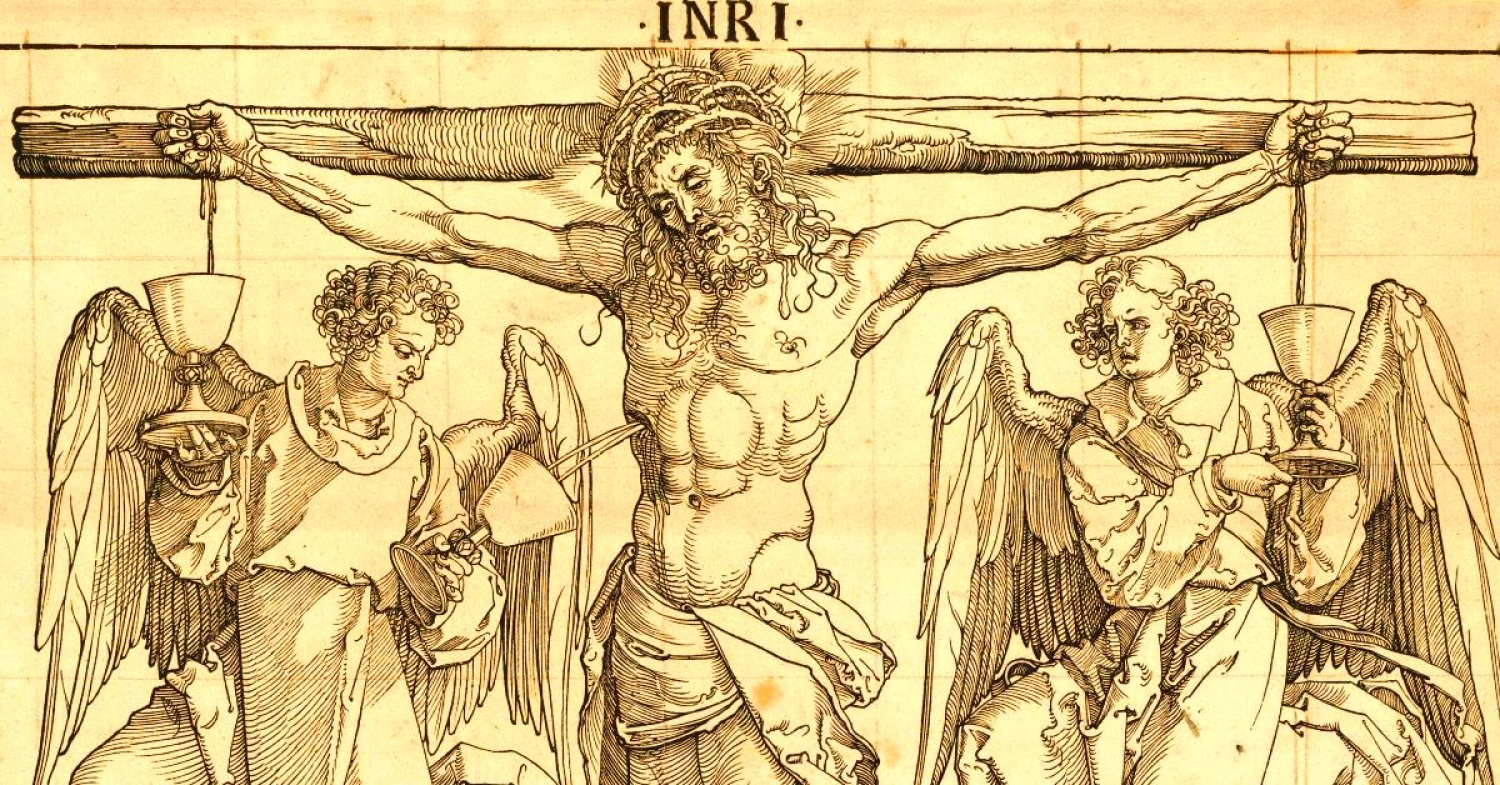
Photo Credit: detail of "Christ on the Cross with Angels" (16th Century) by Albrecht Dürer from rawpixel.
Comments


Topics
- Book of Concord (24)
- Congregational Life (2)
- Seasons and Celebrations (Non Religious) (1)
- Theological Terms and Topics (1)
- Show All
- Faith (306)
- Trust (255)
- Death & Dying (210)
- Justification (201)
- Forgiveness (191)
- Imputed Righteousness (164)
- Eternal Life (163)
- Righteousness (154)
- Repentance (137)
- Resurrection (136)
- Faithfulness (130)
- Baptism (123)
- Grace (120)
- Alien Righteousness (118)
- Vocation (116)
- Hope (113)
- Mercy (90)
- Joy (84)
- Wisdom (75)
- Eschatology (75)
- Love (66)
- Incarnation (65)
- Parables (63)
- Pharisees (56)
- Suffering (54)
- Perseverance (52)
- Humility (52)
- Temptation (52)
- Heaven & Hell (51)
- Apologetics (47)
- Fear (42)
- Rejoice (38)
- Sadducees (27)
- Encouragement (25)
- Persecution (25)
- Redemption (24)
- Evangelism (24)
- Truth (22)
- Beatitude (22)
- Patience (20)
- Gratitude (19)
- Vengeance (19)
- Divine Monergism (19)
- Thankfulness (18)
- Sanctification (17)
- Marriage (17)
- Glory (16)
- Occult (15)
- Courage (14)
- Obedience (14)
- Prayer (11)
- Betrayal (9)
- Authority (9)
- Soul (8)
- Omniscience (8)
- Praise (7)
- The Trinity (7)
- Omnipotence (7)
- Hospitality (6)
- Angels and Demons (6)
- Conversion (6)
- Omnipresence (6)
- Exorcism (6)
- Judaism (6)
- Confession of Faith / Public Confession (5)
- Comfort (5)
- Creation (5)
- Good Works (4)
- Idolatry (4)
- Conscience (4)
- Divorce (4)
- Islam (4)
- Coveting / Covetousness (3)
- Reconciliation (3)
- Charity (3)
- Buddhism (3)
- Missionary/Missions (3)
- The Lord's Supper / Holy Communion (2)
- Sin, Sinning & Sinfulness (2)
- Contentment (2)
- Hypocrisy (2)
- Prophecy (1)
- Artificial Intelligence (AI) (1)
- Acedia (1)
- Date (1)
- Articles - Media - Reviews
- Sermon Categories
- Show All
- Sermons (1036)
- Audio Sermons (955)
- Funeral Sermons (183)
- Psalm Sermons (131)
- Away Sermons (40)
- Wedding Sermon (19)
- Pastors & Church Workers (1)
- Show All
- Pastor Ted Giese (878)
- Rev. Lucas Albrecht (231)
- Rev. Terry Defoe (121)
- Guest Preacher (69)
- Vicar James Preus (26)
- Rev. Lowell Dennis (16)
- Rev. Arron Gust (7)
- Rev. Daryl Solie (5)
- Rev. Howard Ulmer (4)
- Rev. Paulo Brum (4)
- Missionary Rev. Kim (4)
- Rev. Nigel Prozenko (2)
- Pastor Basil Christi (1)
- Synod and Regions
- The Bible
- Show All
- ^John (228)
- ^Psalms (202)
- ^Luke (198)
- ^Matthew (185)
- ^Mark (93)
- ^Romans (56)
- ^Isaiah (41)
- ^Acts (38)
- ^1 Corithians (31)
- ^Revelation (25)
- ^Philippians (22)
- ^Genesis (20)
- ^1 John (19)
- ^1 Peter (18)
- ^Hebrews (18)
- ^Ephesians (18)
- ^Colossians (17)
- ^James (15)
- ^2 Corithians (15)
- ^Galatians (13)
- ^Ezekiel (13)
- ^Ecclesiastes (13)
- ^2 Timothy (12)
- ^Deuteronomy (11)
- ^1 Thessolonians (9)
- ^Proverbs (8)
- ^1 Kings (8)
- ^2 Samuel (8)
- ^Exodus (6)
- ^Job (5)
- ^1 Samuel (5)
- ^Titus (4)
- ^1 Timothy (4)
- ^Judges (4)
- ^Numbers (4)
- ^Philemon (3)
- ^Amos (3)
- ^Jeremiah (3)
- ^Nehemiah (3)
- ^Jude (2)
- ^Habakkuk (2)
- ^Micah (2)
- ^Esther (2)
- ^Leviticus (2)
- ^2 Peter (1)
- ^2 Thessolonians (1)
- ^Malachi (1)
- ^Zechariah (1)
- ^Nahum (1)
- ^Jonah (1)
- ^Joel (1)
- ^Hosea (1)
- ^Daniel (1)
- ^Lamentations (1)
- ^2 Chronicles (1)
- Seasons and Festivals
- Show All
- Pentecost (461)
- Lent (194)
- Easter (153)
- Epiphany (145)
- Advent (107)
- Christmas (74)
- Holy Week (41)
- Christmas Eve (22)
- Easter Day (22)
- Palm Sunday (20)
- Reformation Day (18)
- Transfiguration (18)
- Good Friday (16)
- All Saints Day (16)
- Pentecost Sunday (16)
- Thanksgiving (15)
- Trinity Sunday (15)
- Christ the King Sunday (13)
- Maundy Thursday (13)
- Ash Wednesday (12)
- Baptism of Our Lord (10)
- Feast of Saint Michael and all Angels (2)
- Ascension Day (1)
- Purification of Mary & Presentation of Our Lord (1)