“Parable of the Labourers in the Vineyard” Sunday Sermon / September 20th 2026 Season of Pentecost / Pr. Ted A. Giese / Matthew 20:1–16
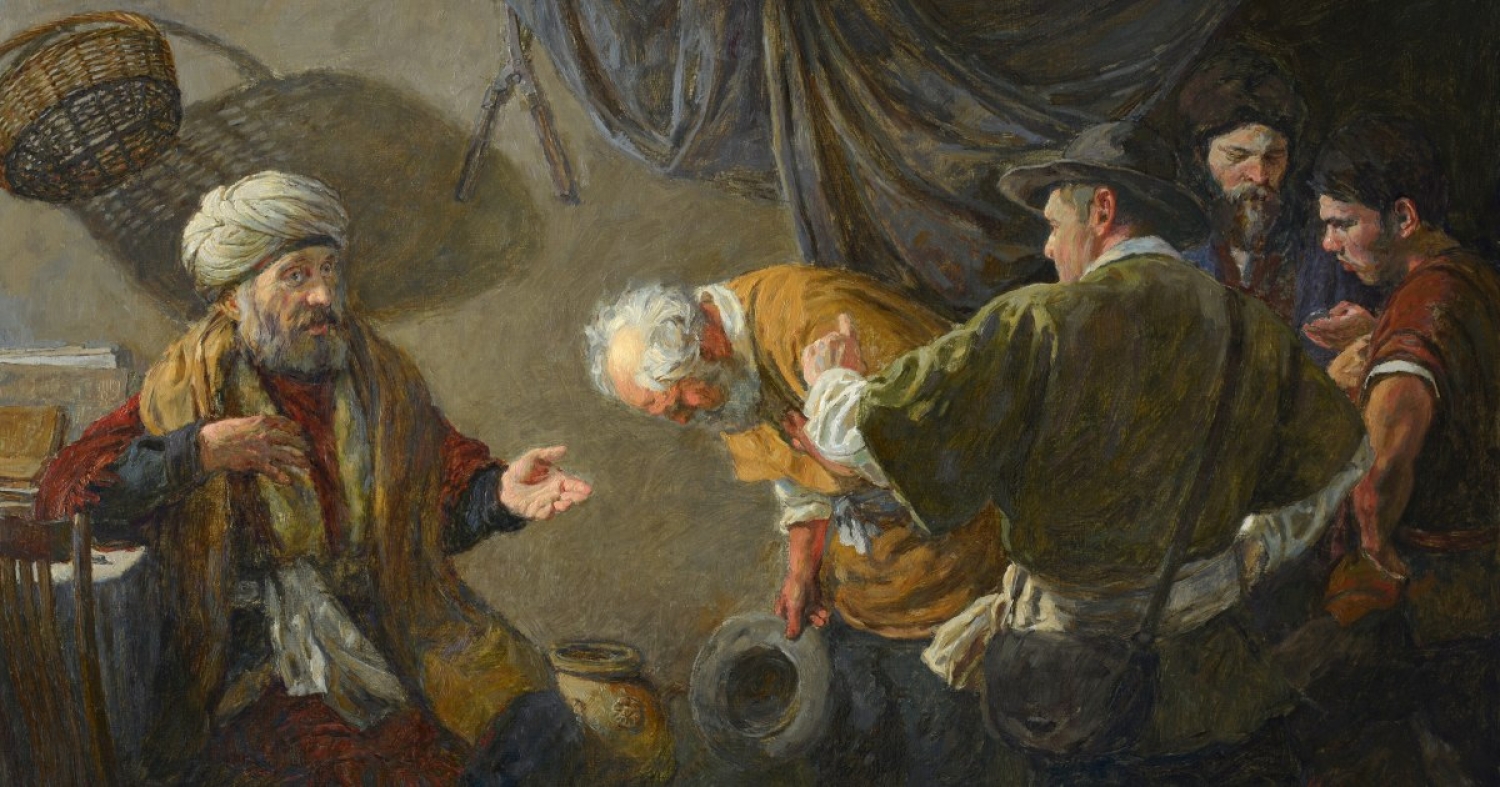
Mount Olive Lutheran Church / Pr. Ted A. Giese / Sunday September 20th 2026: Season of Pentecost / Matthew 20:1–16 “Parable of the Labourers in the Vineyard”
[Jesus teaches] “For the kingdom of heaven is like a master of a house who went out early in the morning to hire labourers for his vineyard. After agreeing with the labourers for a denarius a day, he sent them into his vineyard. And going out about the third hour he saw others standing idle in the marketplace, and to them he said, ‘You go into the vineyard too, and whatever is right I will give you.’ So they went. Going out again about the sixth hour and the ninth hour, he did the same. And about the eleventh hour he went out and found others standing. And he said to them, ‘Why do you stand here idle all day?’ They said to him, ‘Because no one has hired us.’ He said to them, ‘You go into the vineyard too.’ And when evening came, the owner of the vineyard said to his foreman, ‘Call the labourers and pay them their wages, beginning with the last, up to the first.’ And when those hired about the eleventh hour came, each of them received a denarius. Now when those hired first came, they thought they would receive more, but each of them also received a denarius. And on receiving it they grumbled at the master of the house, saying, ‘These last worked only one hour, and you have made them equal to us who have borne the burden of the day and the scorching heat.’ But he replied to one of them, ‘Friend, I am doing you no wrong. Did you not agree with me for a denarius? Take what belongs to you and go. I choose to give to this last worker as I give to you. Am I not allowed to do what I choose with what belongs to me? Or do you begrudge my generosity?’ So the last will be first, and the first last.”
Let us pray: May the words of my mouth and the meditations of all our hearts be acceptable in Your sight O Lord. Amen.
Grace peace and mercy to you from God our Father and from our Lord and Saviour Jesus Christ. Good Christian Friends in the days when Jesus taught this parable a denarius was a standard day’s wages. I guess these days we have minimum wage standards and other labour laws and people make different amounts of money for their labour depending on what kind of work they are doing, and how long they’re doing it. This parable of the labourers in the vineyard isn’t about different wages for different skills and expertise or work experience, rather this parable on the one hand is about a set standard agreement for wages while on the other hand being about false expectations of some of the labourers based on their personal time worked. The parable is also very much about humble joy and arrogant resentment among the labourers.
When considering and thinking about this parable we can ask:
1) Who is the Master—the owner—of the House?
2) What is the vineyard that belongs to the Master of the House?
3) Who are the labourers in the vineyard?
4) What is the denarius that the labourers in the vineyard receive from the Master of the House?
1) In the Gospel of Saint John, the night before Jesus goes to the cross of His crucifixion, Jesus says to His disciples, “Let not your hearts be troubled. Believe in God; believe also in Me. In My Father’s house are many rooms. If it were not so, would I have told you that I go to prepare a place for you? And if I go and prepare a place for you, I will come again and will take you to Myself, that where I am you may be also.”[1] Jesus is teaching His disciples that His Heavenly Father is the Master of a House with many rooms; and in our parable Jesus also talks about a Master of the House with a vineyard. Consider then how it is that in the parable of The Labourers in the Vineyard the Master of the House is God the Father. He looks out and sees labourers who are not in His vineyard and He makes an arrangement with them to come into His vineyard for a particular payment. They will come into His vineyard for the day and receive a denarius, the standard wage for one day’s labour.
2) The original hearers of Jesus’ parable about The Labourers in the Vineyard would certainly be aware of what the Prophet Isaiah says when he explains that “the vineyard of the LORD of hosts is the house of Israel, and the men of Judah are His pleasant planting;”[2] and how the Lord prepared His “vineyard on a very fertile hill. [How] He dug it and cleared it of stones, and planted it with choice vines; [how] He built a watchtower in the midst of it, and hewed out a wine vat in it; and [how] He looked for it to yield grapes, but it yielded wild grapes.”[3] The vineyard of the Lord of Hosts is ancient Jerusalem, but even then, the was city was an emblem for something more, something bigger than a city. By the end of the Bible in the Book of Revelation the New Jerusalem descends out of heaven[4] Saint John describes what he sees like this: “and I saw the holy city, new Jerusalem, coming down out of heaven from God, prepared as a bride adorned for her husband.”[5] Saint Paul in his letter to the Ephesians describes the Church as the Bride of Christ Jesus. So, we have in Scripture a number of ways of talking about the same thing, a thing found in the past, in the present and in the future, something that truly also transcends history, and the now, into the eternal. For us in our day the vineyard of the parable is the Church and our lives lived out in it. Already in the Gospel of Saint Matthew Jesus has taught Saint Peter that Peter’s confession that “Jesus is the Christ, the Son of the Living God” is the confession upon which the Church will be built, and of that Church and confession, Jesus says, “the gates of hell shall not prevail against it.”[6] Such is the Church, such is the nature of the vineyard into which the Master of the House calls His labourers.
3) Which brings us to the Labourers. Perhaps one of the clearest aspects of this parable is that we are the labourers called into the vineyard. God the Father finds us standing idle in the marketplace: He finds us in the morning, He finds us at mid-day, He finds us in the afternoon, He finds us at evening, He finds us at the close of the day, at the eleventh hour. Moses in Psalm 90[7] teaches about time and the Lord saying, “For a thousand years in [the Lord’s] sight are but as yesterday when it is past, or as a watch in the night.”[8] Saint Peter reminds the Christian not to overlook the fact, “that with the Lord one day is as a thousand years, and a thousand years as one day,”[9] so in a parable like the one Jesus is providing what is a day in relation to the labourers in the vineyard? Is it one day? Is it a life time? Is it a time longer than that? Is it the length of the life of a single congregation? Is it the length of the life of the Church it’s self?
For now, let’s take it to mean the length of the life of a person: Some people then are ones are called into the vineyard in their infancy, some in their youth, some in their middle years, some in their old age and some even at the eleventh hour right at the end of their life.
Now, let’s take it to mean the length of the life of congregation: Watching labourers enter the vineyard at any age ought to bring great joy! And for many it does, yet in this parable Jesus tells of those who have been working in the vineyard longer growing unsettled and jealous of the newer workers and the wage they receive, they see what the newer workers receive and because they had lost track of what was promised them and believed they deserved more wages for their longer service they become jealous. Dear ones this ought not be so among us. Resist the temptation toward resentment or feelings of entitlement or ownership over the vineyard. If this has been you, put such feelings away, seek forgiveness; be glad for each new Labourer as they enter the vineyard.
And how does one enter the vineyard anyway? The Church? Through faith in Christ Jesus, though the gift of faith in Holy Baptism, through baptism itself. We are blest to have this in the 11am Service today for Kione. We also have some people joining by transfer and profession of faith. For those already baptised: Remember your baptism, and if you are yet to be baptised remember Jesus has prepared those waters for you and for your washing, for your entrance into the vineyard of the Lord of Hosts.
4) The Standard Day’s Wages (the same one that everyone gets): Not a quote from the Bible but one people sometimes think is from the Bible is the adage “nothing is certain except death and taxes”[10] Saint Paul in his letter to the Christians of Rome teaches “For the wages of sin is death, but the free gift of God is eternal life in Christ Jesus our Lord.”[11] And in the Book of Hebrews we are taught that “it is appointed for man to die once, and after that comes judgment.”[12] Saint Paul in Romans also teaches that “all have sinned and fall short of the glory of God.”[13] If then as we considered, the parable would apply to the whole life of a labourer, and the standard payment a labourer would receive is death for their sin, than what is the denarius that the Master of the House and Lord of the vineyard offers to the labourers in His vineyard? The denarius that each labourer equally receives regardless of whether they start their time in the vineyard in the morning or at noon or in the evening or at the eleventh hour of their life is Jesus Himself. Jesus is the denarius.[14] “for all have sinned and fall short of the glory of God,” [and Paul continues to say] “and are justified by [God’s] grace as a gift, through the redemption that is in Christ Jesus,”[15] and in Hebrews when it says “just as it is appointed for man to die once, and after that comes judgment, so Christ, having been offered once to bear the sins of many, will appear a second time, not to deal with sin but to save those who are eagerly waiting for Him.”[16]
The Parable ends with the phrase “the last will be first, and the first last,” and yet all receive the same wage, not death but life in Christ, the generosity of the Master of the House and the Lord of the vineyard: “For God loved the world in this way, that He gave His only Son, that whoever believes in Him should not perish but have eternal life.”[17] Ask yourself, is there anyone in the parable who the Master of the House doesn’t want in His Vineyard? Jesus says of Himself “the Son of Man came to seek and to save the lost,”[18] and Saint Paul teaches, “Christ Jesus came into the world to save sinners, of whom I am the worst,”[19] and in His letter to the Christians of Rome he writes how “God shows His love for us in that while we were still sinners, Christ died for us.”[20]
That standard wage of death for sin was paid by Jesus, as Saint Peter teaches, when he writes, “you were ransomed from the futile ways … not with perishable things such as silver or gold, but with the precious blood of Christ,”[21] in this way Jesus is the Denarius that we receive as labourers in the vineyard, not one penny less than what is needed for our Salvation and eternal life and not one penny more than was required and yet this gift of Jesus for you is the priceless generosity of the Master of the House do not begrudge that generosity of anyone who has been brought into the vineyard by the Lord as your fellow labourer. Be glad and have great joy when someone finds themselves in the vineyard: What did we hear in our Old Testament reading, “Seek the LORD while He may be found; call upon Him while He is near.”[22]
Finaly to help put today’s Parable into even more context I leave you with this thought to consider: earlier in the Gospel of Saint Matthew—where we find our Parable today—Jesus has already been teaching the crowds that followed after Him saying, “Come to Me, all who labour and are heavy laden, and I will give you rest. Take My yoke upon you, and learn from Me, for I am gentle and lowly in heart, and you will find rest for your souls. For My yoke is easy, and My burden is light.”[23]
Dear ones, lastly consider how, Jesus starts His parable today saying “the kingdom of heaven is like a Master of a house who went out early in the morning to hire labourers for His vineyard.” Remember that same Lord Jesus teaches us to pray to His heavenly Father, that Great Master of the House and Lord of the vineyard, “Thy kingdom come,” and in that prayer we trust that, “the kingdom of God certainly comes by itself without our prayer,” but as the we believe, teach and confess in our corner of the vineyard of the Lord of Hosts, when we pray “Thy kingdom come,” we pray “that [the kingdom] may come to us also,” as a gift from God the Father by His grace.[24] That we would belong to Him, that we would have the Holy Spirit and that we would receive Christ Jesus His Son, His perfect labour in place of our faulty labour, as the generous new standard wage of life in place of the old standard wage of death. One wage provided for all whether you come into the vineyard early or late. Amen.
Let us pray: Lord have mercy on us, Christ have mercy on us, Lord have mercy on us, “take our minds and think through them, take our lips and speak through them, take our hearts and set them on fire; for the sake of our Lord and Saviour Jesus Christ, Amen.
[1] John 14:1–3
[2] Isaiah 5:7a
[3] Isaiah 5:1b–2
[4] Revelation 3:12
[5] Revelation 21:2
[6] Matthew 16:18
[7] A Commentary on Psalms 73-150, John F. Burg, Northwestern Publishing House 2004, Page 142.
[8] Psalm 90:4
[9] 2 Peter 3:8–9
[10] This is modern a distillation of Christopher Bullock’s line “Tis impossible to be sure of any thing but Death and Taxes” from his 1716 play The Cobbler of Preston. In a 1789 letter to French scientist Jean-Baptiste Le Roy about the new U.S. Constitution Benjamin Franklin further refined the sentiment, “in this world nothing can be said to be certain, except death and taxes”
[11] Romans 6:23
[12] Hebrews 9:27
[13] Romans 3:23
[14] Interpreting the Parables, Archibald M. Hunter, The Westminster Press 1960, Page 29.
[15] Romans 3:24
[16] Hebrews 9:27–28
[17] John 3:16
[18] Luke 19:10
[19] 1 Timothy 1:15
[20] Romans 5:8
[21] 1 Peter 1:18–19
[22] Isaiah 55:6
[23] Matthew 11:28–30
[24] The 2nd Petition, The Lord’s Prayer, Luther’s Small Catechism, Concordia Publishing House 2017, page 20.
Photo Credit: Main Photo "Parable of the workers in the vineyard." by A. Mironov from wikipedia/commons.
Comments


Topics
- Book of Concord (24)
- Date (8)
- Sermon Categories (7)
- The Bible (6)
- Show All
- ^John (210)
- ^Psalms (200)
- ^Matthew (173)
- ^Luke (163)
- ^Mark (80)
- ^Romans (59)
- ^Acts (39)
- ^Isaiah (38)
- ^1 Corithians (30)
- ^Revelation (22)
- ^Philippians (21)
- ^1 John (18)
- ^1 Peter (18)
- ^Genesis (17)
- ^Hebrews (16)
- ^Colossians (16)
- ^Ephesians (16)
- ^Galatians (13)
- ^2 Corithians (13)
- ^Ezekiel (13)
- ^James (12)
- ^2 Timothy (12)
- ^Ecclesiastes (12)
- ^Deuteronomy (10)
- ^1 Thessolonians (9)
- ^2 Samuel (8)
- ^Proverbs (7)
- ^1 Kings (6)
- ^Exodus (6)
- ^Job (5)
- ^1 Samuel (5)
- ^Titus (4)
- ^Judges (4)
- ^Numbers (4)
- ^Philemon (3)
- ^1 Timothy (3)
- ^Amos (3)
- ^Jeremiah (3)
- ^Jude (2)
- ^2 Thessolonians (2)
- ^Habakkuk (2)
- ^Micah (2)
- ^Esther (2)
- ^Nehemiah (2)
- ^Leviticus (2)
- ^2 Peter (1)
- ^Malachi (1)
- ^Zechariah (1)
- ^Nahum (1)
- ^Jonah (1)
- ^Joel (1)
- ^Daniel (1)
- ^Lamentations (1)
- ^2 Chronicles (1)
- Seasons and Festivals (5)
- Show All
- Pentecost (401)
- Lent (174)
- Easter (133)
- Epiphany (122)
- Advent (91)
- Christmas (62)
- Holy Week (38)
- Christmas Eve (18)
- Easter Day (18)
- Pentecost Sunday (17)
- Palm Sunday (17)
- Reformation Day (15)
- Good Friday (14)
- Transfiguration (14)
- All Saints Day (13)
- Thanksgiving (13)
- Trinity Sunday (13)
- Maundy Thursday (12)
- Ash Wednesday (11)
- Christ the King Sunday (10)
- Baptism of Our Lord (7)
- Theological Terms and Topics (4)
- Show All
- Faith (275)
- Trust (242)
- Justification (186)
- Death & Dying (180)
- Forgiveness (165)
- Imputed Righteousness (152)
- Righteousness (133)
- Eternal Life (132)
- Repentance (118)
- Resurrection (117)
- Alien Righteousness (115)
- Faithfulness (113)
- Vocation (103)
- Grace (101)
- Baptism (101)
- Hope (99)
- Joy (77)
- Mercy (76)
- Wisdom (66)
- Eschatology (54)
- Incarnation (53)
- Love (49)
- Pharisees (48)
- Parables (48)
- Apologetics (48)
- Humility (47)
- Heaven & Hell (41)
- Temptation (40)
- Suffering (37)
- Perseverance (36)
- Fear (35)
- Rejoice (34)
- Sadducees (24)
- Persecution (24)
- Evangelism (23)
- Vengeance (19)
- Truth (18)
- Beatitude (18)
- Divine Monergism (17)
- Encouragement (16)
- Glory (12)
- Marriage (12)
- Occult (12)
- Thankfulness (11)
- Gratitude (10)
- Sanctification (10)
- Obedience (9)
- Redemption (9)
- Patience (8)
- Omniscience (8)
- Betrayal (7)
- Authority (7)
- Judaism (7)
- Soul (6)
- Courage (5)
- Prayer (5)
- The Trinity (5)
- Conversion (5)
- Praise (4)
- Missionary/Missions (4)
- Omnipresence (4)
- Exorcism (4)
- Islam (4)
- Omnipotence (3)
- Divorce (3)
- Idolatry (2)
- Creation (2)
- Buddhism (2)
- Conscious (1)
- Artificial Intelligence (AI) (1)
- Acedia (1)
- Congregational Life (3)
- Seasons and Celebrations (Non Religious) (2)
- Articles - Media - Reviews
- Synod and Regions